


We need to break down the photovoltaic power generation process as in the diagram below:
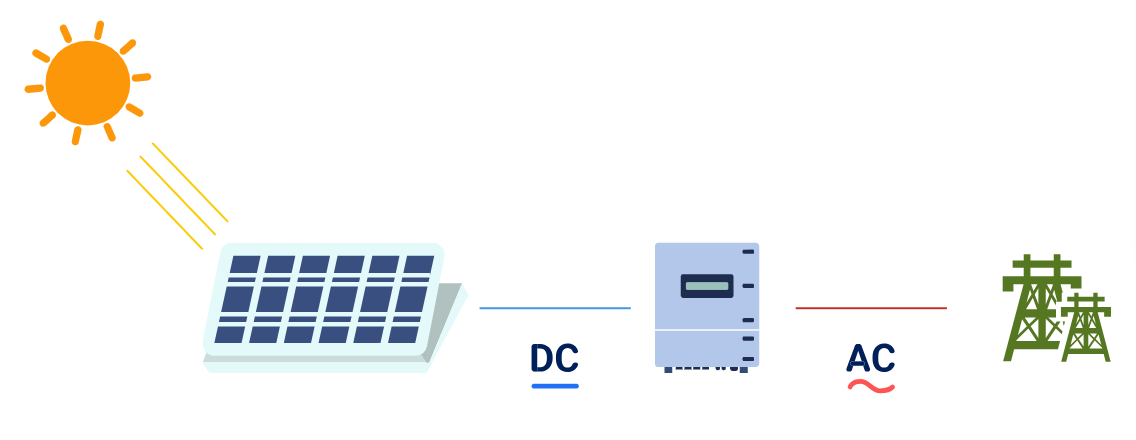
First of all, the energy source for photovoltaic power generation comes from capturing solar irradiation. So how to set the inclination and orientation of the modules to ensure that the module surface and sunlight have as small an angle as possible to obtain as much irradiation intensity. When sunlight strikes the module surface, all obstruction factors can cause a loss of irradiation, such as shadows, dirt, accumulated dust, snow, and even bird droppings, branches falling, and other foreign objects. If double-sided modules are used, since the back of the module can also capture a certain amount of reflected light, the power generation gain compared to the same specification single-sided modules can reach 5-30%.
Then we focus on the process of converting solar energy into direct current electricity by the modules. Currently, the mainstream monocrystalline silicon modules on the market can reach an energy conversion efficiency of about 25% under ideal conditions (laboratory environment), but the actual conversion efficiency is about 18% or even lower. So what factors affect this conversion process? The first is the impact of environmental factors on the module's power generation efficiency. One of the major adverse factors is temperature rise. Each degree of temperature increase can cause a certain degree of decline in the module's power generation efficiency. In addition to the natural temperature rise, the module's temperature rise caused by poor ventilation should also be considered. Secondly, if a string inverter is used, string mismatch is also a major factor affecting power generation efficiency. The main factor of string mismatch comes from the shading of shadows. Due to the shading of shadows, the power generation efficiency of a module in the string is greatly reduced, which in turn affects the output of the entire string and greatly reduces power generation. Of course, there are other situations that cause string mismatch, such as deviations in the production and manufacturing process (within an acceptable range), which limit the output of the entire string to the module with the lowest power generation efficiency. It is worth noting that depending on the direction of the shadows and the location of the bypass diodes on the module, choosing to arrange the modules horizontally relative to the shadows will significantly improve the output compared to vertical arrangement.
In addition, the loss of direct current wiring or direct current cables cannot be ignored. The connection of various modules and cables may cause a drop in voltage during transmission, leading to a loss of electricity. According to the famous industry article "Performance Parameters for Grid-Connected Systems" published by the National Renewable Energy Laboratory (NREL) in the United States, in general, in a string inverter system, this loss can be set between 2% and 2.5%. When using a microinverter, since the module is directly connected to the inverter, there is no direct current string wiring, which can eliminate or greatly reduce this kind of loss.
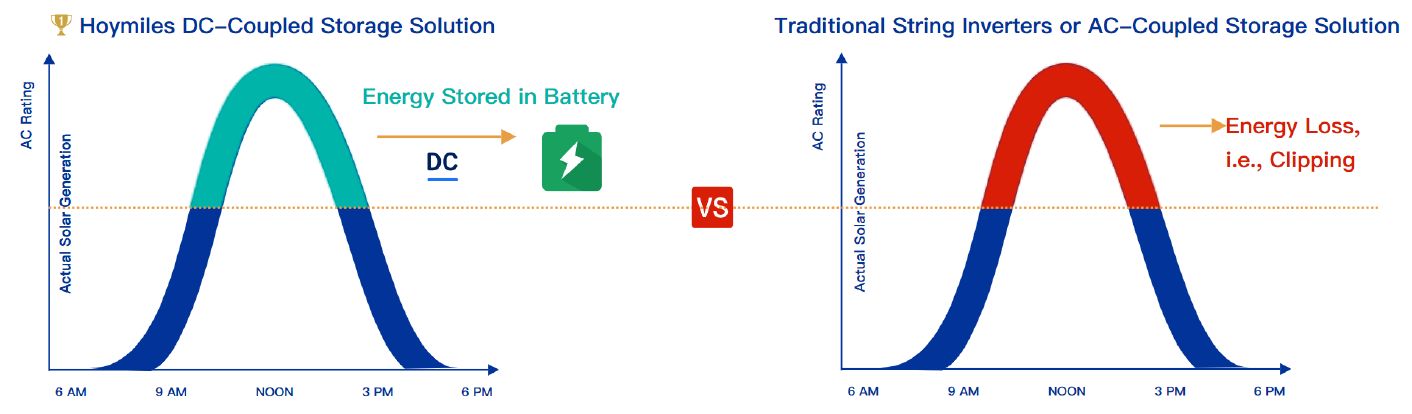
Next, let's look at the losses on the inverter side. On the one hand, the inverter's conversion efficiency (converting the direct current electricity generated by the photovoltaic modules into alternating current electricity). Using Hoymiles microinverters can achieve module-level maximum power tracking to maximize the power generation capacity of each module. On the other hand, due to its excellent design, it can reach a conversion efficiency of up to 96.6%. All of the above can be verified by the module power, inverter power generation, and grid-connected electricity data that each owner can view in real-time using the S-Miles Cloud APP. On the other hand, common losses include the peak clipping loss caused by over-sizing. The DC-Couple design of Hoymiles hybrid inverter can directly store the clipping loss caused by direct current electricity into the battery, which can achieve a larger over-sizing ratio (150%~200%, much higher than the traditional inverter system's 110%~140%) in the design stage, thus saving costs for the owner and recovering investment faster.
Finally, looking at the system as a whole, on the one hand, the system will have an annual decline. Assuming that the system retains 80% of its power generation capacity after 20 years, the calculation shows an annual decline of 1%, that is, we predict that this system will have 1% less power generation capacity than the previous year each year. On the other hand, for various reasons, such as equipment failure and maintenance power outages, the system may be temporarily unavailable as a whole. Therefore, a 1-2% annual system unavailability ratio should be set to assess this situation. When we assess the power generation of the photovoltaic system, only by considering these factors can we obtain a more realistic annual power generation within the system's lifecycle, rather than over-optimistically evaluating the entire system.
In summary, this article introduces various factors that may cause a loss of photovoltaic system power generation. In fact, there are other factors that can cause the power generation to be less than expected. The National Renewable Energy Laboratory (NREL) in the United States has a more detailed discussion in the famous industry article "Performance Parameters for Grid-Connected Systems." Moreover, in practical situations, due to different types of modules and different types of inverter systems, different effects may be produced under different climate conditions and natural environments, so the weight of these factors will also fluctuate within a certain range depending on the actual situation. Through the Hoymiles Smiles-Cloud cloud platform entering the Smiles-Designer design platform, you can clearly see the losses of the system in different power generation stages and environments, as shown in the figure below. Photovoltaic practitioners are eliminating various adverse effects through various means, and it is believed that the efficiency of photovoltaic systems will be higher and higher in the near future.