


Introduction
Solar power continues to expand rapidly across residential and commercial & industrial (C&I) applications. While modern PV modules offer increasingly high conversion efficiency, system performance is still heavily influenced by external factors such as solar angles, irradiance conditions, and shading.
Accurate solar angle analysis combined with professional irradiance and shading assessment helps maximize energy production and improve overall project returns.
Optimizing PV panel azimuth and tilt based on accurate solar angle data paired with professional shadow & irradiance calculation maximizes solar energy capture and cuts generation losses from shading. Centered on domestic PV design scenarios in China, this article elaborates core solar angle definitions and introduces how S-Miles Designer leverages ray tracing algorithms to precisely compute irradiance and shadows cast by rooftops, obstructions, and trees for high-precision 3D PV design, enabling engineers to deliver power-optimized PV solutions.
I. Solar Azimuth Angle
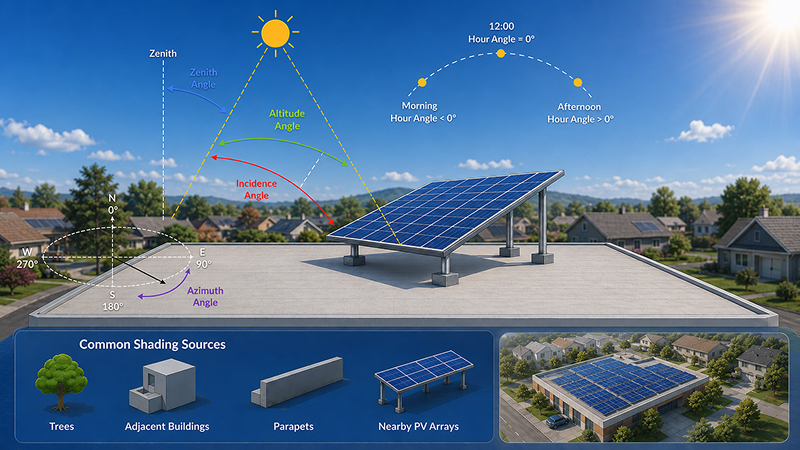
Solar azimuth refers to the clockwise horizontal angle between incoming sunlight and true north, defining the sun’s horizontal position and acting as the core reference for PV array orientation design.
Standard benchmark values:
- True North = 0°
- East = 90°
- True South = 180°
- West = 270°
For most regions across China, south-facing orientation (~180°) delivers optimal performance. S-Miles Designer auto-detects roof orientation and quickly recommends the best-fit azimuth layout.
II. Solar Altitude Angle
Solar altitude is the vertical angle between sun rays and the horizontal horizon, indicating how high the sun sits above the skyline.
Its value is governed by three variables:
- Time of day
- Seasonal date
- Site geographic latitude
Higher solar altitude means more direct vertical sunlight, the ideal condition for PV power production.
Complementary to zenith angle, this parameter governs the vertical tilt design of PV panels.
III. Solar Zenith Angle
Zenith denotes the point directly overhead in the sky.
Solar zenith angle measures the angle between sunlight and the vertical zenith line.
Core mathematical relationships:
- Zenith Angle = 90° − Solar Altitude Angle
- cos(Zenith Angle) = sin(Altitude Angle)
These formulas form part of the underlying calculation logic for S-Miles Designer’s annual solar irradiance and power yield computation.
IV. Hour Angle
Hour angle quantifies the angular offset of the sun relative to local solar noon, expressed in degrees.
- Noon (12:00): Hour angle = 0°
- Every 60 minutes before or after noon results in a 15° angular shift
- Negative values occur before noon; positive values occur after noon
This parameter supports full-day solar orbit simulation, and S-Miles Designer uses hour angle to compute real-time irradiance and shadow variation throughout the day.
V. Solar Declination Angle
Declination is the tilt angle between sun rays and Earth’s equatorial plane, fluctuating yearly due to Earth’s axial tilt.
Typical values:
- Summer Solstice: +23.5°
- Winter Solstice: −23.5°
- Annual variation range: −23.5° to +23.5°
Declination causes seasonal differences in solar irradiation.
S-Miles Designer embeds full-year declination datasets to simulate seasonal power output fluctuation and optimize panel tilt for year-round sunlight utilization.
VI. Incidence Angle
Incidence angle is the angle between incoming sunlight and the normal line (perpendicular) of the PV panel surface.
- 0° incidence: Vertical irradiation, maximum solar absorption efficiency
- 90° incidence: Glancing irradiation, minimum energy utilization
A primary PV design objective is to adjust mounting tilt and orientation so the incidence angle remains as close to 0° as possible during peak sunshine hours.
S-Miles Designer allows customized mounting tilt settings to refine incidence angles and improve system performance.
VII. Shading: Hidden Cause of Generation Loss
Shadows from trees, adjacent buildings, parapets, and nearby PV arrays can severely reduce system output, making shading one of the most common sources of energy loss in residential and C&I PV projects.
Significant climatic differences across China create substantial seasonal variations in solar altitude and shadow coverage, making year-round shading assessment essential.
Powered by ray tracing algorithms and Google 3D DSM terrain data, S-Miles Designer performs point-by-point light projection simulation across rooftops, surrounding structures, and vegetation to calculate annual irradiance distribution and shading patterns.
It helps designers eliminate unsuitable shaded areas, maximize usable rooftop space, and generate more reliable energy production estimates.
Accurate shading analysis requires more than traditional 2D roof layouts. By leveraging 3D site models, terrain data, and ray-tracing technology, designers can better understand how surrounding objects affect solar access throughout the year and make more informed layout decisions.
VIII. FAQ about Solar Angles in S-Miles Designer
Q1: What is the optimal tilt angle for PV panels?
A common design guideline is to install panels facing south with a tilt angle close to the site's geographic latitude.
In practice, slightly lower tilt angles are often preferred in southern China, while slightly higher tilt angles may be suitable in northern regions.
S-Miles Designer automatically calculates and recommends optimal tilt and azimuth settings based on project location.
Q2: How can I quickly calculate solar angles?
While simplified formulas can provide rough estimates, accurate PV design requires consideration of location, season, time of day, terrain, and shading conditions.
S-Miles Designer automatically performs these calculations and simulations, allowing users to complete angle analysis, power estimation, and layout optimization with minimal manual effort.
Q3: What is a solar zenith angle?
The solar zenith angle is the angle between incoming sunlight and the vertical zenith line directly overhead.
It is commonly used to evaluate solar position and optimize PV panel orientation.
Q4: How is solar zenith angle calculated?
Zenith Angle = 90° − Solar Altitude Angle
S-Miles Designer automatically performs these astronomical calculations and provides accurate solar angle data without manual lookup.
Q5: What is the difference between azimuth angle and zenith angle?
Azimuth Angle
- Describes the sun’s horizontal position (East, South, West)
- Determines the facing direction of PV modules
Zenith Angle
- Describes the sun’s vertical position
- Influences panel tilt and irradiance conditions
Together, these two parameters help optimize PV array orientation and maximize energy production.
IX. Conclusion
Maximizing PV output depends on accurate solar angle analysis, proper panel orientation, and effective shading management.
Adjustable mounting systems combined with professional irradiance and shading analysis can significantly improve energy yield and project return on investment.
S-Miles Designer integrates high-precision ray-tracing shadow analysis, comprehensive solar angle calculations, 3D terrain simulation, and intelligent auto-layout capabilities into a single design platform.
It realizes one-stop PV design covering angle optimization, shading evaluation, component arrangement, and final proposal generation, helping installers reduce engineering effort and accelerate high-quality project delivery.