

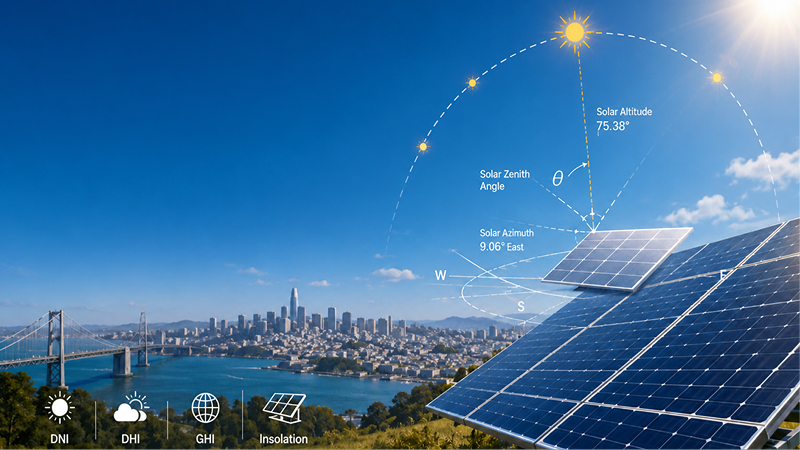

Solar irradiance is one of the most important factors affecting photovoltaic system performance.
Accurate irradiance analysis helps designers estimate energy production, optimize system layouts, and improve project profitability. Combined with shading analysis, it forms the foundation of professional PV system design.
Photovoltaic power generation stands among the most reliable and scalable renewable energy solutions available today. The term “photovoltaic” derives from two roots: “photo” referring to sunlight and “voltaic” relating to electric power generation. All PV systems follow the same core working principle: converting solar electromagnetic radiation into usable electricity via PN junctions inside semiconductor cells.
The power output and efficiency of any photovoltaic plant are predominantly governed by one key environmental indicator: solar irradiance.
Solar irradiance quantifies sunlight intensity arriving at a project site and serves as the fundamental parameter for PV scheme design, power yield calculation, and system optimization. Whether for residential rooftop PV, commercial distributed power stations, or large-scale ground-mounted solar farms, accurate irradiance calculation is an indispensable preliminary step for project implementation.
Specialized PV design software such as S-Miles Designer automates remote irradiance mapping to eliminate manual computation, avoid calculation errors, and drastically reduce pre-design workload. This guide systematically elaborates on basic definitions, core classifications, and field calculation methods of solar irradiance to help engineers develop refined site-specific PV designs.
1. Definition of Solar Irradiance
The sun continuously emits massive electromagnetic energy in the form of light and heat. PV power generation mainly harnesses visible light, ultraviolet radiation, near-infrared rays, and other spectral bands of solar radiation, which can be absorbed and converted into electricity by photovoltaic cells.
Solar irradiance is defined as the instantaneous solar power received per unit area, measured in watts per square meter (W/m²), which directly reflects real-time sunlight intensity at a given location.
Reference Benchmark
The average extraterrestrial solar irradiance (solar constant) outside Earth’s atmosphere is approximately 1361 W/m².
After passing through the atmosphere, sunlight undergoes atmospheric scattering, gaseous absorption, cloud shielding, terrain obstruction, and seasonal variations, resulting in lower ground-level irradiance that fluctuates dynamically across locations and times.
2. Four Core Classifications of Solar Irradiance
Solar radiation reaching the ground consists of three constituent components whose combined value determines the total energy input of PV systems. Understanding these categories is critical for power generation simulation and system optimization.
2.1 Total Solar Irradiance (TSI)
TSI refers to solar radiation measured at the top of Earth’s atmosphere and serves as the reference value for solar resource calculations.
2.2 Direct Normal Irradiance (DNI)
DNI is solar radiation traveling directly from the sun to the ground after excluding energy lost to atmospheric scattering and absorption.
Measurement is taken on a surface perpendicular to incoming solar rays.
Tilt-mounted PV modules rely heavily on DNI for high output, making it a major contributor to utility-scale solar generation.
2.3 Diffuse Horizontal Irradiance (DHI)
DHI refers to solar radiation scattered by atmospheric particles before reaching the Earth's surface.
It serves as an important energy source for PV systems during cloudy, foggy, or hazy weather conditions.
Although lower in magnitude than DNI, diffuse irradiance remains a valuable contributor to total solar energy production.
2.4 Global Horizontal Irradiance (GHI)
GHI represents the total solar radiation received on a horizontal surface and is the most widely used metric for evaluating solar resource potential.
Formula:
GHI = DHI + DNI × cos(θ)
Where:
- DNI = Direct Normal Irradiance
- DHI = Diffuse Horizontal Irradiance
- θ = Solar Zenith Angle
GHI provides a comprehensive representation of available solar resources at a given location.
3. Impacts of Shading on Irradiance and Power Output
Shading is one of the most significant factors reducing PV system efficiency.
Contrary to common assumptions, even small areas of shading can affect the performance of an entire module string, resulting in disproportionate power losses.
Research Finding
Renewable energy expert Professor Gil Masters demonstrated that shading a single cell within a standard 36-cell PV module can reduce the module’s total power output by more than 75%.
Traditional manual shading assessments and irradiance calculations are often time-consuming and prone to inaccuracies.
S-Miles Designer addresses this challenge through high-performance simulation technology. The platform evaluates more than 5,000 solar position scenarios for a single project and generates high-precision irradiance heatmaps and shading analysis reports within seconds.
By combining Google 3D terrain data, rooftop models, and ray-tracing technology, S-Miles Designer enables designers to evaluate shading impacts throughout the year and identify the most productive installation areas.
This allows accurate design evaluation without extensive on-site surveys, significantly improving project efficiency and design accuracy.
4. Core Advantages of S-Miles Designer
During the pre-sales and design stages of solar projects, traditional site visits and repeated parameter adjustments often increase labor costs and extend project timelines.
Through remote irradiance simulation and intelligent shading analysis, S-Miles Designer streamlines the entire workflow.
Key benefits include:
- Reduced need for preliminary site surveys
- Faster project evaluation and proposal generation
- Improved design accuracy
- Lower pre-sales labor costs
- Shorter design cycles
From solar resource assessment to module layout optimization, every design decision is supported by data-driven analysis, helping installers create high-yield PV systems with stronger financial performance.
Conclusion
Solar irradiance is the foundation of scientific and high-efficiency PV system design.
Rather than being a fixed value, irradiance is influenced by geographic location, season, time of day, atmospheric conditions, and surrounding terrain.
By understanding irradiance classifications and calculation principles, designers can avoid assumptions, improve design accuracy, and unlock the full energy potential of a project site.
S-Miles Designer simplifies complex irradiance calculations and shading simulations through intelligent automation, helping installers and designers create more accurate, reliable, and profitable PV projects with greater efficiency.